Wednesday, October 31, 2018

Namaste Nepal | Project Partner's visit in Nepal 2017

Every year Namaste Nepal's development partners had been visiting Nepal to observe the recent activities so this year altogether 29 partners were here in Nepal for the same purpose as well as for trek. NNK had been excited to welcome such a huge number of guests. The date they arrived was during the Dashain festival and all the schools were in festival vacation. Thus, partners had plotted plan to go for the trek first and then go for the project area. Following are the activities carried out during the Development partner's visit in Nepal 2017. On 29th Sept, 2017 Delft team arrived in Nepal with 11 Dutch, they were transferred to the hotel. Similarly following day of it, on 30 sept Freiberg and Buchen team arrived with 18 Germans. Both team were welcomed by NNK project Coordinator Nima Tshering Lama at Tribhuwan Int'l Airport (TIA) and after both Dutch and German's arrival in Nepal, Social tours had organized a tour to Swayambunath Temple then a combine welcome Dinner at Bhojangriha , Dillibazar Kathmandu. The dinner program had been the simplest way to make friends and to create communication medium and broadcast carrier which implies boundless collaboration for the project and endless intensions.

On 1st October group was taken for city tour to visit Pashupati Nath Temple to learn about the importance of this temple for Hindus and similarly they had visited Boudha Nath Temple to learn about the importance of the Stupa for the Buddhists.

On 2nd October both German and Dutch left Kathmandu to Pokhara for Khopra and Mardi trek. Germans gone for the Mardi trek and Dutch for the Khopra trek but both team were together up to Ghandruk. NNK's Asst. Coordinator had joined with Dutch team for the Khopra trek. Both team reunited at Pokhara and knew that they had beautiful time in the trek. However none of them had any unpleasant experience during trek.
On 12th October, after 10 days of trek both group arrived at Kathmandu in the late evening because of the traffic on the way. So they didn't have any time for market since they were planning to purchase some materials for the schools.

On 13 October all the development partners along with NNK staffs and German TV journalist Mr. Harmot headed to Dandakateri and Gati. Shree Kali Devi Secondary school, Gati SMC, teachers,parents and students were standing at Tyangyhali with Panche Baja (a folk nepali musical instruments) to welcome the Freiburg and Buchen group whereas Shree Seti Devi Basic school, Dandakateri had organized a welcoming ceremony at school premises. Both teams were accommodated with home stay.  TV journalist was actively working with interviews and shooting since we started our Gati trip.


On 14 October, in the morning some partners went to field with Gati Coffee Nursery man to observe the coffee plants and its situation. In the same time those who were not interested to walk for coffee tour had a Momo making session in the Gati kindergarten's kitchen.
Shree Seti Devi Basic School, Dandakateri had organized grand welcome program for all the guests arrived in Gati and Dandakateri on the same day. School had cultural sharing programs with some speeches. In the middle of the program Buchen went to Sotang as they had to walk uphill for about 2 hrs and had to manage the stay too. They had camp in the school premises for 2 nights. During their stay in Sotang, planned to observe the project sites and recent activities of it.
On 15 October, Shree Kali Devi Secondary school Gati had a grand welcome and felicitation program for Partners, Delft group joined it but Buchen were unable to join them. Shree Kali Devi School had cultural exchange program where both school and partners had demonstrated their own talents. In the program NNK had felicitated SEE graduates and hand over the Samir shrestha memorial scholarship for 3 students of Shree Kali Devi Secondary School. Gati Coffee project even handed over 10% of its profit to the education fund of Shree Kali Devi Secondary school. Buchen had informal welcome program at Sotang by SMC, school and parents. Buchen team played with school kids and watched class activities.
On 16 October, Mandra Bal Bikash A.T.A. Kendra and Gorakhnath Basic school had organized welcome programs, Freiberg went for the program and walked to Sotang collecting Buchen , Delft visited Sotang and had informal talks with Sotang school team and walked down to Dandakateri together. Delft stayed at Dandakateri and rest went back to Gati. On this day Buchen team had walked around Sotang village to see the villagers and cleaned all the classrooms and office.

On 17 October,Shree Kali Devi Secondary School had school's new building ground floor slab concrete work, Freiberg and Buchen team worked  voluntarily with paid laborer , After lunch all the team had interaction with students, observe the activities of the classroom, computer class & devices and took a lesson with students. Partners were able to learn about the educating system in Gati school.
Freiberg team, NNK and SMC had combine meeting in the evening on the overall performance of the project.
On18 October, Schedule was set to get back to Kathmandu so Freiberg, Delft and Buchen team had farewell program in nepali tradition at Gati and Dandakateri, and walked down to Highway. From highway bus collected all of them to drive back to Kathmandu. After arrival in Kathmandu a combine dinner program was set for all.
On 19 October combine meeting was made in presence of the board members and development partners at Decheling restaurant in noon. The agendas for the meeting were more about school operation like teacher's English language speaking training, teacher's durable stay, Hostel service for students, instruments intactness and utility. Similarly Partners were concerned about the project's sustainability; motivate villagers/stakeholders to hold social ownership of the project belongings and close concern about the fund raising campaign to construct school's buildings. Delft team had flight back to hometown on this day, 20th October 2017 Early morning Freiberg and Buchen flew back to Germany as per the flight schedule.

Namaste Nepal | Project observation by development partners during Nepal visit in 2018

Special Celebration!!! in Gati
The Namaste Nepal's project development partners from Namaste Nepal S-GmbH, Freiberg-Germany, Namaste Nepal Grotious, Delft- Holland, Freiberg and Namaste Nepal S-AG Bunche-Germany along with some friends of Namaste Nepal from Germany and Holland had visited project site in Gati, Dandakater and sotang village of Barhabise Municipality ward No 6. The group arrived during Dashain festival, all the Nepalese were in festive mood so the project area and stakeholders  as well. Mostly every year at our project site villagers have had special Dashain celebration as our development partners travels during the festival time. This time Gati, Dandakateri, Sotang were fortunate to welcome 46 guest all the way from Germany and Holland. Each group stayed in their own project sites to learn closely and veritably.
Basically the main purpose of the project visit by the development partners are to:-
1. analyse the process of implementation, focusing on participation of the community
2. analyse the impact or changes that have occurred within beneficiary households and the community
3. identify problems and constraints that have been encountered
4. identify important lessons to be learnt and make recommendations for the implementation of future projects.
Regardless evaluations are usually carried out at the end of a project so this visit could be taken as monitoring and observation program. 
Namaste Nepal had been working mainly on educational development and with it different activities like women empowerment, Coffee Project, health center and School reconstruction has been carried out. It means NNK is working in broader scale  in the improvement of education and its sustainability

Though the project was started with one school and with small fund, none might not had imagined Namaste Nepal project would incline in such a height with huge responsibilities. 
However development partners and implementing partners are putting efforts together for the development of the educational, economic and social status of the project areas. The team of Namaste Nepal and partners are trying best for the effective and best results from major activities. The major fund raising activities of Namaste Nepal takes as great achievement to collect handsome amount during Nepallauf (Nepal Run)that had been organized in different town of Germany, Holland as well as in Kathmandu this year.
The beneficiaries of the project also tried to collect some fund during the school event at Gati by selling Mo:Mo(Dumpling) and local organic Gati coffee to support the educational fund for sustainability. Shree Kali Devi Secondary School's students, SMC, parents, teachers and German Guest were engaged in the Mo:Mo making activity and from this they could earn about 18000 NRs from Mo:mo and 2260 NRs for selling local coffee to the visitors, which was excellent start to collect fund for the education.

Enthusiasm of developing partners and implementing partners seems great this year. Following are the supportive clues that advocates about the relevance, effectiveness, efficiency, impact and sustainability of the monitoring and observation program at project site by the developing partners.

  1. Relevance: As Namaste Nepal designs the project plan every year before the end of the November with the help of need assessment of the beneficiaries by the implementing partners.And also the project plan get study in 3 level i.e. Beneficiaries and program coordinator designs the plan together and this plan forwarded to the board member of the organization then finally if board passes this plan forwarded to the development partners and with the collective talk within the supporting partners on the plan and final plan is implemented. Thus in this sense, the activities that had been carried out by the project are relevant in the present context of the project sites.
  2. Effectiveness: 
    1. To broad extent the intended outputs and outcomes level indicators  achieved in the relation to targets set up in the project document;
    2. the project approach is very effective and appropriate because our target and objective mitigates with the output of the project.
    3. Well beneficiaries and stakeholders participation is quite good and incorporated in the project cycle.
    4. Developing partners were in project sites only for 4 days, first day was spent to walk around the village, school building, second day was spent to visit whole project sites of Namaste Nepal and observation, third day was spent on school's welcome program and forth day was spent to work for the school by students. 
  3. Efficiency: These two years back Namaste Nepal had been investing big budget for the project areas because of School building construction and other regular activities. So far funding, staff those who are paid by Namaste Nepal seems energetic and smart to fulfill the organization's goal, regular activities are going according to the timeline but the reconstruction project is taking longer time than organization had expected, and other resources like coffee project, mother group and health center are contributing for achievement of the results. And from the project activities the value of money is achieving gradually though it's not easy to gain.
  4. Impact:
    1. So far the impact is the result which could be seen after long duration. But in the recent context project has been putting some positive impact in the project sites. The project activities are connected with each other's goal so it will be definitely helpful in impacting the lives of the people. Some activities are for once in a year for an example school coffee project, mother group motivation and run to school event so stakeholders get energies before some months of the activity date. However each activity has been taken as agent of committing for long term impacts. 
    2. The benchmarks of the project achievements are different on the basis of project nature. The developing partners and implementing partners had never expressed about the topic nor workout on it. So Namaste Nepal would get concrete impact with data.
    3. The direct beneficiaries of the project is school kids of the project sites and wider beneficiaries are coffee farmer, mother group and villagers. 
  5. Sustainability: 
    1. The prospects of the project being sustained are not merely continuing program, but developing relationships, practices, and procedures that become a lasting part of the community.
    2. When the topic sustainability comes in discussion every one focus on the fund collection for the program specially when the program is totally related to the empowerment. Namaste Nepal have started thinking about self-dependent at the project sites and also started implemented in practices. Run to School event, coffee project, handicrafts from mother group and other fund raising programs.  Namaste Nepal has a prospect of having 100% literate rate of the project sites and well-being life of the villagers. Villagers were not aware of providing education for the kids, health and economic development. So project has started to empower villagers by supporting them and creating appropriate phenomena. 
  6. Overall observation
    1. impact on beneficiaries and the community
    2. community participation
    3. selection and processing of beneficiary
    4. project management and implementation process.
  7. Strengths of the project: The development partners portray the staff commitment,staff efficiency, organizational links and strong local presence, level of government support, availability of resource, successful activities of project implementation etc.
  8. Views and comments:Combine meeting with stakeholders, beneficiaries and development partners was held on last evening of village stay. The ideas of meeting is to have further plan to bring stakeholders together as project is expanding step by step. Gati village has been a catchment area to implement program activities in all the project sites so to get equal progress collective effort of stakeholders is needed. The effort of the stakeholders could be different nature as they have different features, there was good discussion on basic school and secondary school's effort on fund collection. But basic school could give surface ideas about the project which will definitely helpful when they go secondary school.The beneficiaries are not that much active as expected and it has been main hindrance of the project. So, to motivate the stakeholders and beneficiaries there should be expedition of model village who has worked an exemplary work by themselves. The idea of connecting all stakeholders through social networks like facebook group, skype or any other application using the internet to discuss about the project. Ex-students of the schools could play vital role on the organization goal achievement. 
  9.  Beside this, each project site should focus on self sustainability for the holistic development of village. We may be little bit backward in starting phase to earn fund but it will give general concept ideas of fund raising for future. Following are the general ideas that created from past experiences.
    • More coffee you produce more fund you collect
    • What if student choose Agro farming in their higher education, it may be coffee farm as coffee project is already there in their village for economic development.
    • People gets more active when they are challenged so development partners had challenge with all the beneficiaries who could earn more from coffee. 
    • Nepallauf event is now popular in Germany and it is the major event to collect handsome amount for the project, this year Namaste Nepal started with good result, thus it should be continued in coming years too.
    • Mo:Mo and coffee selling was impressive, it could be one of the fund collecting event.
    • Mother group exported cotton shopping bag at Germany, it also could be the one.
    • If you put your effort and ideas, it's not hard to raise fund for your self........
Education is not only about schooling a formal lesson for the kids. Development partners are putting efforts for educational development in Nepal as well as giving very authentic lesson to their kids about the self sustainability and it is the lesson for long term. These days villagers are much more aware about educating their kids because they literally thinks that educating their kids means having brighter life of their kids and investing something on them which is also a good saving as a pension for their retired life.

Monday, April 24, 2017

Peace Education Tour


The project peace education and library has been designed for the enhancement of peace education and library in Gati VDC. Shree Kali Devi Secondary School will be the first introduction of peace education and library program among entire Gati, Sindhupalchok. IMAGINE PEACE is a network of people who work for peace in various areas such as culture, arts, education, citizens’ movement, and publication that had provided financial support for the project. And in coordination of Namaste Nepal a part of this project, Peace education tour had been organized on 10th April 2017 for 8th grade of the school. 24 students, 3 teachers, a SMC member and for the tour coordination a staff was participated in the tour. Namaste Nepal had allocated NRs. 350000/- budget for the tour and remaining budget shall be spent for peace education library as well as planned to continue as an annual program.
Tour participants
The plan of this tour was to appreciate multi culture of Nepal which could be the basic foundation of flourishing the peace through travel by school kids. Peace has been related with traveling by reaching, observing and knowing the facts directly delivered by the concerned people and place. Namaste Nepal set off for the journey for peace at Chitwan (Tharu Culture), Lumbini (birthplace of Lord Buddha, the light of Asia), Madrasa (informal educating institution of Islam religion) and Pokhara ( Gurung culture,famous for hospitality).
A six days journey awaited us to Chitwan from Sindhupalchok. The plan was to kick off from there. We were traveling by Bus that took us to Kathmandu in 4 hours. During the trip, along with the Araniko highway we travelled through a number of beautiful villages, towns with magnificent views. First morning of the journey, we stopped for breakfast at a bus stop called Zerokilo, Kavrepalanchok. Though it is small market, business carried out by different vendors which remain mainly transit for meal. We continued our journey and passed through Dhulikhel, a very picturesque town. We were mesmerized by its beauty and authenticity and it certainly felt like a special place to view majestic mountains in North. There were a number of shops selling groceries, the local cuisine, and at the far end of the town at the junction where the treks heading to Nagarkot start, there was a bus station and fuel center nearby. Half an hour later we reached Bhaktapur, beautiful historical town which is the valley touched with Kathmandu valley. There, we had driven on an invigorating and wide fast track road, supported by Japan Government. In the meantime, kids started to vomit because of motion sickness as they had never travelled such a long distance by bus. Those kids were pampered by school teachers whereas other was lookin
g out onto the scene from the window. After leaving Bhaktapur and before we reached Tribhuwan Highway, we came across our capital city of Nepal where we stopped to get some bottle of water. Almost all of the roads were dusty and polluted, traffic jam was the major problem of time consuming. It seems that the construction work was too delayed to accomplish. We reached Thankot a bit later in the noon than planned. We chose to have our lunch at Naubise as we were already late for the lunch hour. We wanted to reach soon at our destination and behold the awe-inspiring views at the National park which we had read about only in our text book. Chitwan national park is the oldest national park of Nepal and famous for bio diversity. At Chitwan, we rushed up to the hotel before the sun set but we could check in only at 8 pm.
  Before we go for the bed, all of our participants expressed their first day traveling experience and divided into 5 sub group for the project work about this tour. The sub division of project work was as follows:
·         Report writing
·         Photography
·         Antique piece collection
·         Story/ history collection
·         Interviewing/ questioning

For the report writing purpose Hira Shrestha along with 4 kids were divided, similarly for photography Urmila Tamang along with 3 kids were divided, for Antique piece collection Sajan Tamang along with 4 kids were divided, for Story/history collection Rojina shrestha along with 4 kids and for interviewing Kusum Tamang along with 3 kids were engaged in the stuff. Teachers were ready to assist the kids to have perfect project work. Next day, our guide was ready to make a tour and walk around with us with lots of information about the place and Tharu culture. The views viewed while walking around there, were stunning. The sun shining on the far horizon, the scent of flower coming from the jungle with the bird song brought a pleasant sense of well-being that nourished all our senses. It all came together in perfect harmony as the sun slowly rose up in the sky.
Walking to reach Tharu settlement
 We had already witnessed Tharu settlement, exceptionally picturesque and charming village whose houses were built in the old style, giving a sense of both radiance and genuineness. After the livelihood and historical background informed by our guide, our participants poured all the queries with him. It is said that Tharu were migrated from the thar desert of Rajasthan,India. Agriculture and animal husbandry is the main occupation of this ethnic group. Nowadays Tourism is another earning occupation for them.
Tharu houses
The Government policies for inhabitant and had demolishing malaria campaign was informed to the kids. Kids were listening with great curious and rapidly questioned with guide. There were so many queries in their mind regarding to the religion, literacy, house pattern, income, festival, attire and ornaments, fuel and forest regulation and many more.
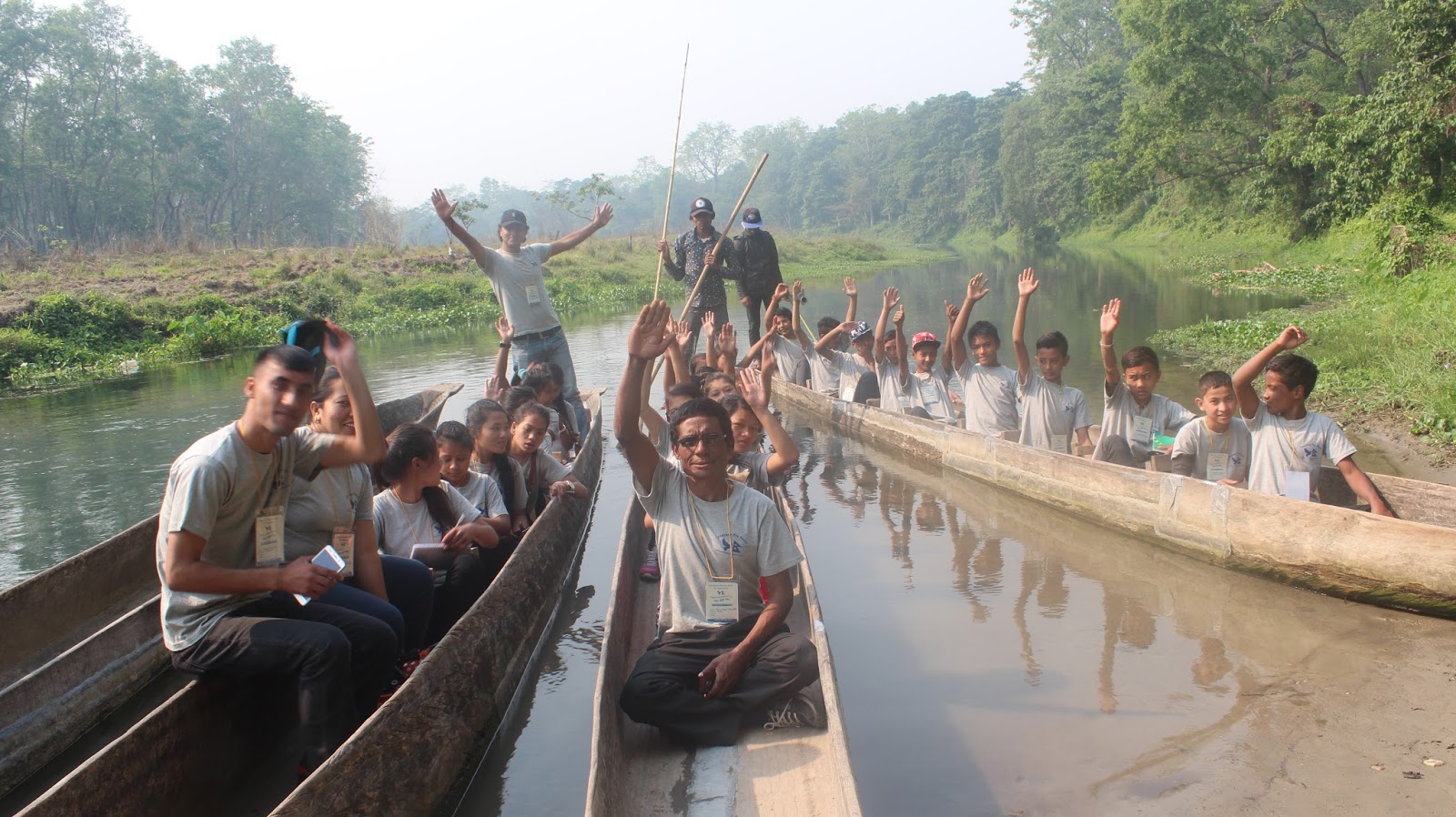
Next program of the day was to do canoeing at Rapti River. The canoeing was a bit challenging as the river was habitat of crocodile. The jungle with wild animal made it a little challenging to have jungle walk but the views from there were phenomenal and it was well worth the effort.
We found a handcraft shop which manufactures paper from elephant dung and craft different beautiful items from it. Kids those who were divided in antique piece collection were searching for the Tharu related items. We had set a time for Tharu cultural museum visit after our lunch and we did accordingly.
Canoeing at Rapti river 
Observing Tharu cultural museum
Tharu cultural museum was small and beautifully demonstrated traditional items and overall information about the Tharu culture. We spend almost an hour there. Guide took back us to the hotel and briefed about the evening program, i.e. visit to elephant breeding center, Khorsor and Tharu cultural house.  We have plenty of time in between so we managed this time for the recap session of the day. Kids tried to trace out all the information that they were informed by guide and whatever they observed. The presentations were satisfactory, must say they did well.   
Presenting daily report of the tour 
In comparison of 10 years time interval Chitwan has been populated and traditional houses and daily life is gradually changing. Our guide gave information about the conflict between elephant and local is often occurred. For the precaution, Local use electrical current in iron wire bounded around the National Park. Kids concluded that not only within human rather human and animal also should live in harmony for the Peaceful environment. During the stay at Chitwan, knowing the Tharu culture was somehow adding different perception and lifestyle of them. We could find Tharus has commercialized their culture and having good income.
Next destination of this tour was Lumbini, Kapailbastu District. There we had planned to visit different monastery built by many international Buddhist association and more importantly we have to visit Madrasa( Islam educating school). The tour's third day, we visited all those which were in our itinerary and preferred to stay at Korean Buddhist temple, Lumbini.
In the premises of Maya devi temple, Lumbini
Whenever we try to figure out peace, Lord Buddha comes in our mind. What we felt and tried to maintain the peace within the premises of Buddha garden.

candle lightening for peace @ korean buddhist temple
The entire monastery has the life history of Lord Buddha. Tourist were seems like they had been lost in meditation, there wasn't exact place for yoga or nor has managed meditation cushion but whole Buddha Garden was look like meditating point.Mayadevi temple and Ashoka pillar has been taken a historical important place, which is the evidence of birthplace of Lord Buddha is Lumbini. We had candle lightening program around the pond nearby Maya Devi temple but managing team didn't let us to do so.
Thus, we lightened it in front of Korean Temple at evening.  It was quite blissful moment to share about the peace and its impact in circle.
Students of Madrasa, Parsachok lumbini
However our main assignment was to observe and interact with muslim kids of Madrasa who are having informal education focused on Islam religious education. Students of Madrasa are allowed to go home only on weekend. District Education Office has provided license up to grade 5 to the Madrasa. So they have only one teacher provided by Nepal government. Madrasa and their situation is totally different than public school. They have to learn Urdu and Arabic script and the way of writing is opposite than other, it is written from right corner to left.  We got common answer from every kids of Madrasa that they want to be Headmaster of Madrasa in future.
World peace pagoda visit, Pokhara 
Forth day of the tour was planned for the Pokhara, it is the largest city of Nepal. We were supposed to get information about the Gurung Culture but we neither able to manage key informant nor could visit Gurung settlement. We had limited time and trapped in traffic caused by road accident. We could reach Pokhara lately and couldn't manage according to the plan. In Pokhara we visited Barahi temple, Phewa Lake, Peace Pagoda built by Japan, Davi's fall and Gupteshor Mahadev Cave. Our half day was well spent at Pokhara.We came back to Kathmandu in 5th evening of our tour. Kathmandu was gloomy and cold. Next morning we had our schedule to visit Swoyambhunath temple and Pasupatinath temple. These both temples are listed in UNESCO world heritage sites.
Swoyambhunath temple visit, Kathmandu
We saw some street people at Kathmandu who slept under the seat of bus stand while there was continue hailstone rain and thundering night.Peace is all about having proper basic needs, and it is fundamental rights which also have been secured in our newly applied constitution.
However, this 5 night 6 days peace education tour had been wrapped up with new experience. The major objective of this tour was to appreciate different culture residing in different regions. In brief students studied and observed Tharu culture, elephant and human conflict, Islam educating system and world heritage sites.

"To some the streets are more than just streets, they are a home."

And before we leave, student were asked to write report according to the work division, Thus,  student's written report will be collected soon and document it for the library and also photographs and handicrafts purchased during the tour related to the theme will be displayed in library. We had realized that such travel should be organized annually for the secondary level student who actually has maximum curiosity and age of building conception and perception.
 LEARN---->SHARE---->GROW
                                                                                                                                                             - Karsang Lama(Asst. Coordinator)